







Earth’s Vital Signs: Taking the Pulse of Our Planet
By Ruta N -"Nevertheless, current scientific evidence indicates that seven of the nine planetary boundaries have already been breached... This scenario significantly elevates the risk of compromising the Earth's vital life-support systems." — An article by the Ruta N Think Tank.
Human activity has evolved into a formidable geological force, capable of reshaping the planet not only through the intensity of our actions but through their unprecedented scale and velocity. Rapid population growth, industrialization, and the intensive consumption of energy and natural resources have left an indelible mark on the air we breathe, the water we drink, and the land we inhabit.
The concept of the Anthropocene defines this new geological epoch—a period where human agency has become a primary driver of global environmental change. Decisions made by humanity now directly influence planetary dynamics that once responded almost exclusively to natural processes.
Since the late 20th century, the scientific community has warned that the negative effects of human activity are no longer confined to local impacts; instead, they are pushing the planet toward states of instability and unpredictable imbalance. Shifts in climate, ecosystems, and natural cycles demonstrate that Earth is becoming increasingly sensitive to anthropogenic pressures.
A Diagnostic Framework for the Planet
In 2009, a group of scientists introduced the Planetary Boundaries framework. Much like a clinical check-up where a physician evaluates vital signs—such as blood pressure, pulse, or blood oxygen levels—these boundaries serve as a diagnostic tool for Earth. Their purpose is to identify the thresholds within which humanity can safely operate without jeopardizing the stability of the systems that sustain life.
Just as a doctor intervenes when vital signs exceed healthy ranges to prevent adverse outcomes, the planetary boundaries function as an early warning system. They aim to identify and mitigate the impacts of human activity before we reach irreversible points of no return.
These vital signs monitor nine critical biochemical and physical processes. When one or more of these boundaries are breached, the planet’s ability to self-regulate is compromised. This can trigger abrupt, irreversible environmental changes with potentially devastating impacts on ecosystems and all forms of life that depend on them.
Defining the "Safe Operating Space"
The primary goal of this framework is to establish what scientists call a "safe operating space for humanity." These boundaries act as a stress test, indicating how much pressure Earth’s systems can endure before losing their capacity for resilience and stability.
Surpassing these thresholds does not always result in immediate or visible disaster. However, it significantly increases the risk of triggering large-scale, abrupt environmental shifts whose consequences could persist for generations, affecting both the natural world and human societies.
Furthermore, these boundaries do not exist in isolation; they are deeply interconnected. Human actions affecting one process can exacerbate risks in others—such as biosphere integrity or ocean acidification. Long-term planetary stability depends on the complex interplay between these biophysical processes.
The Current Diagnosis: 7 of 9 Boundaries Transgressed
Respecting these nine limits is essential for maintaining Earth’s resilience. However, current scientific evidence indicates that seven of the nine planetary boundaries have already been crossed, with ocean acidification being the most recent addition to the list. This reality poses an urgent challenge for collective global action.
What are we measuring? These are the seven boundaries we have exceeded:
1. Climate Change: Driven by rising concentrations of CO₂ and other greenhouse gases, leading to accelerated global warming.
2. Biosphere Integrity: Transgressed through both the loss of genetic diversity and the erosion of functional ecosystem integrity. This boundary has been in breach since the late 19th century, reflecting a profound biodiversity crisis.
3. Novel Entities: This refers to the large-scale introduction of synthetic substances—such as plastics, chemical compounds, and GMOs—into the environment without adequate long-term impact assessments.
4. Land-system Change: Deforestation, agricultural expansion, and urbanization have reduced global forest cover (tropical, temperate, and boreal) below levels considered safe for essential ecological functions.
5. Biogeochemical Flows: The natural cycles of nitrogen and phosphorus have been drastically altered by industrial and agricultural activities, creating a nutrient imbalance that affects water bodies and soils globally.
6. Freshwater Change: This includes "blue water" (rivers, lakes, and aquifers) and "green water" (soil moisture available to plants). Its transgression was confirmed in 2022 after incorporating human impact on green water.}
7. Ocean Acidification: The most recently breached boundary. As oceans absorb atmospheric CO₂, their pH levels drop, hindering the ability of marine organisms to form shells and weakening the ocean’s role as a planetary regulator.
Currently, only two boundaries remain within the safe operating space: stratospheric ozone depletion and atmospheric aerosol loading. However, the latter is under increasing regional pressure, signaling potential future risks
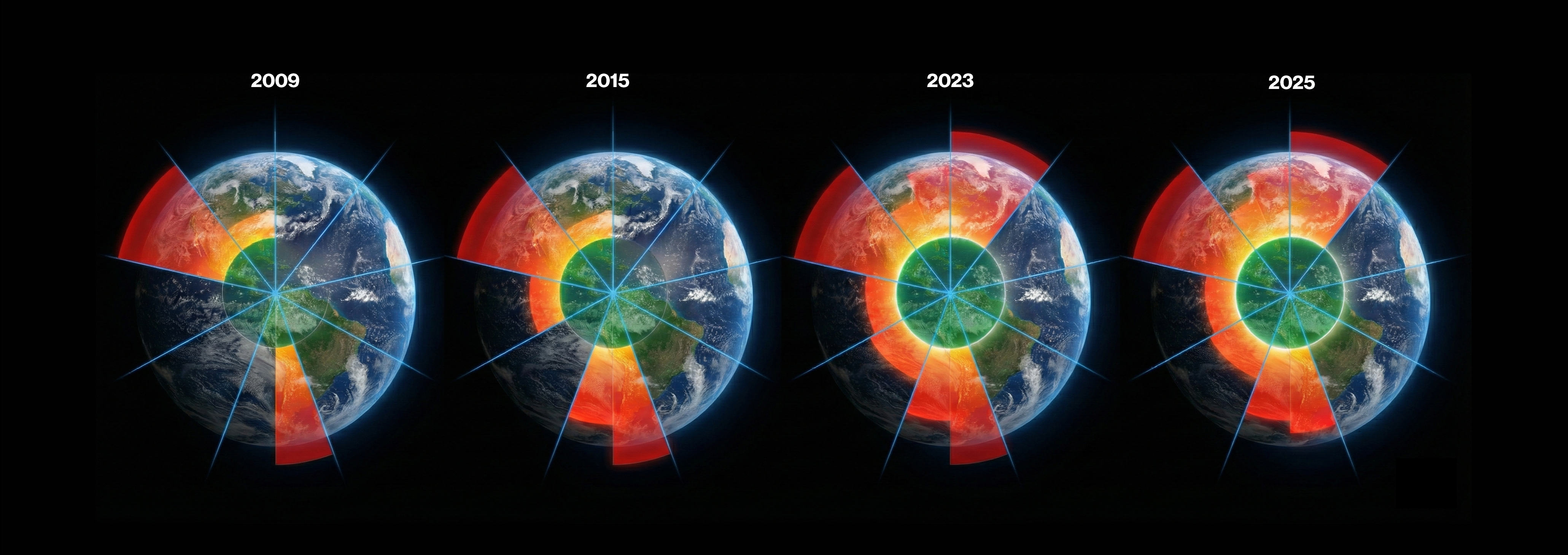
Understanding planetary boundaries is more than a scientific exercise; it is a vital tool for assessing the health of our home and anticipating future scenarios. Just as a medical diagnosis allows for intervention before a condition becomes terminal, this framework provides clear signals of the pressure we are exerting on life-support systems.
In an increasingly interconnected world, respecting these limits requires a collective responsibility that reshapes our political decisions, economic models, production methods, and daily habits.
Did you find this content insightful? Explore more articles from the Ruta N Think Tank, such as:
Ruta N: 4 claves para entender cómo el Foro Davos 2026 puede impactar el ecosistema CTi de Medellín
Used bibliography
De 3 a 7 límites planetarios rebasados: radiografía de la salud del planeta. (s. f.). Medio Ambiente — Universidad Externado de Colombia. Recuperado el 11 de febrero de 2026, de https://medioambiente.uexternado.edu.co/de-3-a-7-limites-planetarios-rebasados-radiografia-de-la-salud-del-planeta/
Stockholm Resilience Centre. (s. f.). Planetary boundaries. https://www.stockholmresilience.org/research/planetary-boundaries.html
Brand, U., Muraca, B., Pineault, É., Sahakian, M., Schaffartzik, A., Novy, A., … Görg, C. (2021). From planetary to societal boundaries: An argument for collectively defined self-limitation. Sustainability: Science, Practice and Policy, 17(1), 265–292. https://doi.org/10.1080/15487733.2021.1940754