




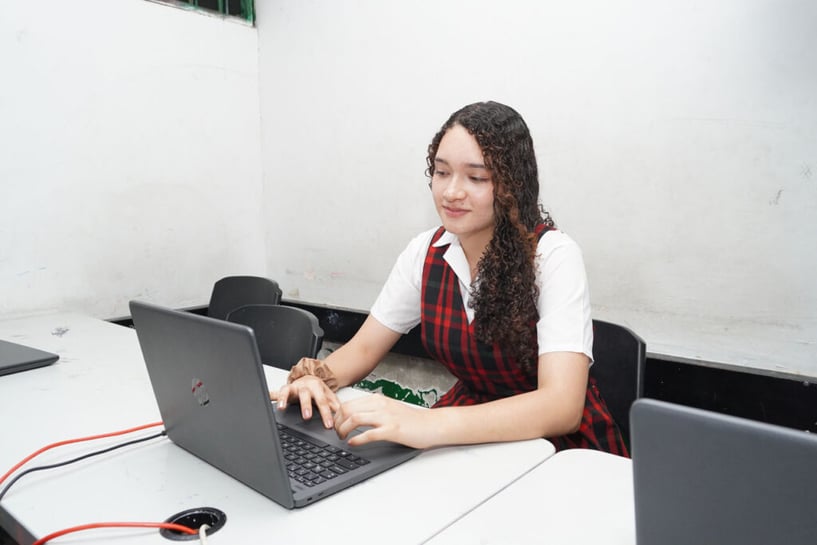
Carol and Medellín: A Story of Science That Began Among Crops and Dreams
By Ruta N -She is part of Ruta N’s Generación Tech program, which reaches 208 educational institutions across the District.
When Carol Guzmán talks about agriculture and technology, she does not speak from theory. At just 14 years old, she already knows rural life firsthand because she grew up in it. Until a few months ago, she lived on a farm in San Andrés de Cuerquia, in northern Antioquia, where she learned to observe the rhythms of the land, the work of those who cultivate it, and the challenges faced by farming families. Today, from a classroom in the Castilla neighborhood of Medellín, she is beginning to imagine how science and technology could help transform that reality.
Although her voice is shy, her ideas are not. As she talks about the project she is developing alongside her ninth-grade classmates at Diego Echavarría Misas Educational Institution, one recurring image emerges: the possibility of one day returning to her parents’ farm to make their work easier. “I’ve imagined it,” she says when asked whether she would like to modernize the agricultural processes she has known since childhood. In her mind, there are already automated gardens, smart irrigation systems, and technologies that would allow crops to be monitored and animals to be fed simply by checking a mobile app.
Her interest in finding solutions was born long before she arrived in the city, but it began to take shape this year through Ruta N’s Generación Tech program, which introduces more than 5,000 children and young people to the world of innovation and technology. There, Carol and six classmates began working on an idea aimed at addressing a challenge that is becoming increasingly important for cities: how to produce food sustainably.
The Idea
.jpg?width=1200&height=800&name=Carol3-1024x683%20(1).jpg)
Their proposal is a rainwater-powered aquaponics system. Although it is still in the ideation stage, its creators already describe it with remarkable precision. Everything begins with a tank designed to collect rainwater. The water then flows into a fish tank where fish produce waste that serves as a natural source of nutrients. Next, the water circulates to the plants, allowing them to grow without soil while making efficient use of resources a cycle in which both fish and crops benefit from one another.
The idea emerged after several weeks of exploration. At first, the proposals seemed too ambitious or difficult to implement. Gradually, however, the group began refining concepts, researching possibilities, and asking how a real need could be transformed into a viable solution. Since the sessions began in March, the project has evolved continuously, and every new question has challenged them to think further.
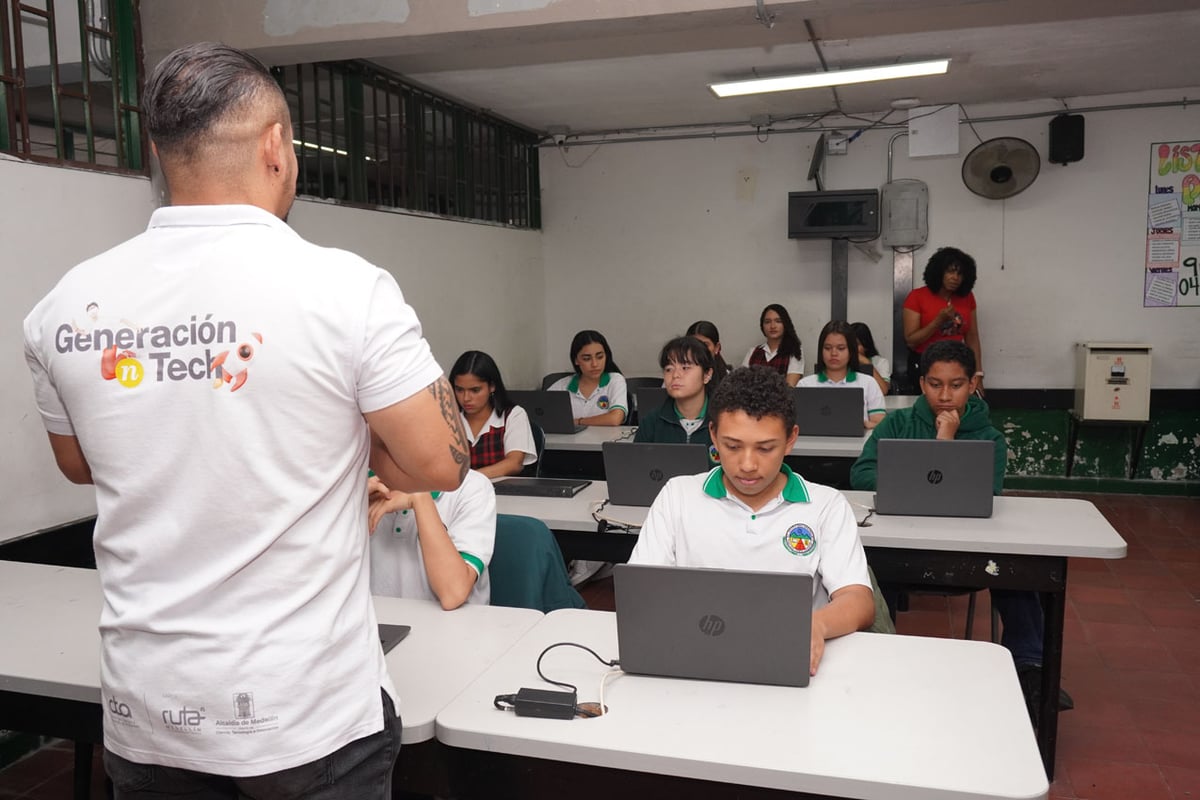
How much water will the system need? How many plants could be cultivated? How can proper water oxygenation be guaranteed? These are some of the questions that have become a fundamental part of the learning process. Rather than seeking quick answers, the students are discovering how scientific thinking works: observing, questioning, experimenting, and trying again.
Learning to Research in Order to Transform Their Environment
Teacher Deyvis del Carmen Becerra, a biologist who has taught at the institution for 16 years, has guided the process. For her, the value of the project extends far beyond physically building the system. What matters most is that students learn how to conduct research and connect technological knowledge with real-world challenges in their communities. In Carol’s case, that connection was evident from the very beginning.
“They were always focused on rural life,” the teacher explains. “They wanted to identify solutions for rural communities and figure out how to apply what they were learning.”
That perspective allowed a personal life experience to become an opportunity for innovation.Carol acknowledges that Generación Tech has taught her things she never imagined. She has learned about artificial intelligence, automation, and new ways to grow food while making better use of resources. Perhaps the most important lesson, however, has been discovering that technology can become a tool for improving people’s lives.
As the project moves toward its construction phase, scheduled for the coming months, the student continues exploring a path that is only just beginning. She enjoys drawing, interacting with artificial intelligence tools, and spending time with her family. She is also beginning to discover what she wants to do as an adult. She does not yet have a definitive answer, but biology, science, and innovation are becoming increasingly important among her options.
Perhaps that is why, when she imagines the future, she does not think only about laboratories or universities. She thinks about returning to the place where it all began: a farm nestled among the mountains, where a curious girl watched life grow around her. Now, that same girl is beginning to understand that science can also be planted. And that, with patience, knowledge, and creativity, its fruits can reach far beyond any crop.
The Program
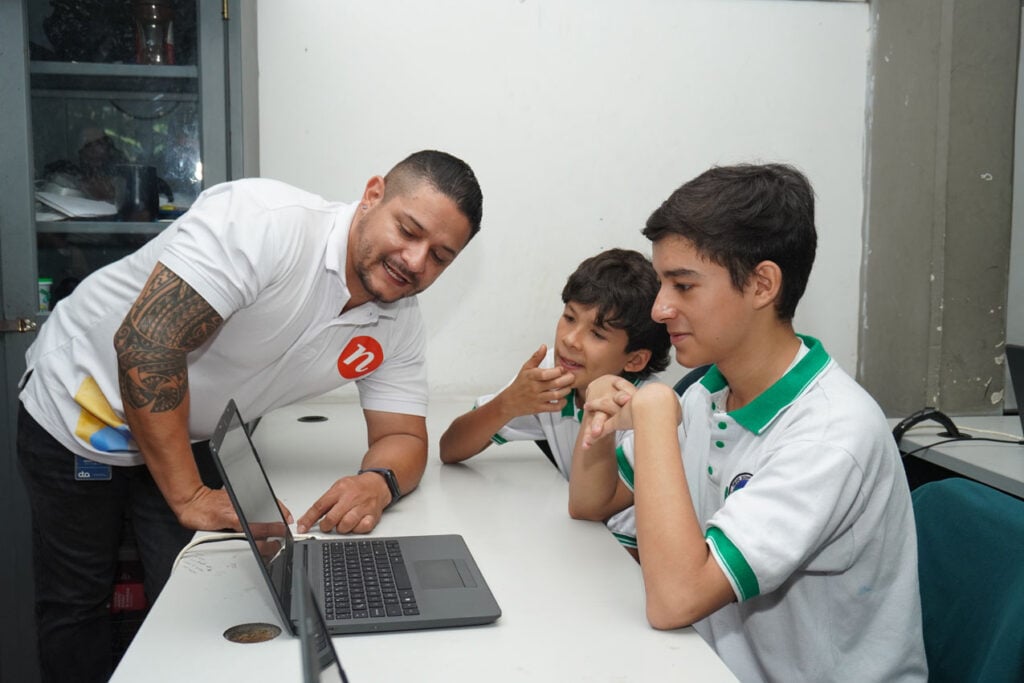
The third edition of Generación Tech marks a turning point for this Ruta N-led program. In 2026, the initiative brings together more than 5,000 students and 417 teachers from 208 public and private educational institutions across Medellín. This represents a 725% increase compared to previous years, expanding the program’s reach by more than seven times.
The program’s purpose is to strengthen the capabilities of children and young people in areas related to science, technology, and innovation through hands-on experiences focused on solving real-world challenges. This year, the initiative also reached the entirety of Medellín’s territory for the first time, including all 16 urban districts (comunas) and the city’s five rural townships (corregimientos).
The training program includes 56 hours of instruction and combines methodologies such as Design Thinking, Challenge-Based Learning, and the STEAM approach, which integrates science, technology, engineering, arts, and mathematics. Throughout the process, participants move through different stages, from exploring challenges to building and validating prototypes, and ultimately presenting their solutions.
The projects developed by students address issues with social and urban impact, including digital security, access to healthcare services, mobility, water source protection, waste management, educational innovation, civic participation, and tourism. To support these efforts, participants incorporate emerging technologies such as artificial intelligence, the Internet of Things (IoT), robotics, blockchain, and 3D printing.
The journey concludes with an innovation fair where teams present their solutions to representatives of the city’s science, technology, and entrepreneurship ecosystem. The event serves as a showcase for young talent and the potential of their ideas to contribute to Medellín’s transformation.
Through programs such as Generación Tech, Ruta N seeks to strengthen a model that connects education, technology, and local communities to empower new generations capable of leading solutions to the challenges facing their territories.